
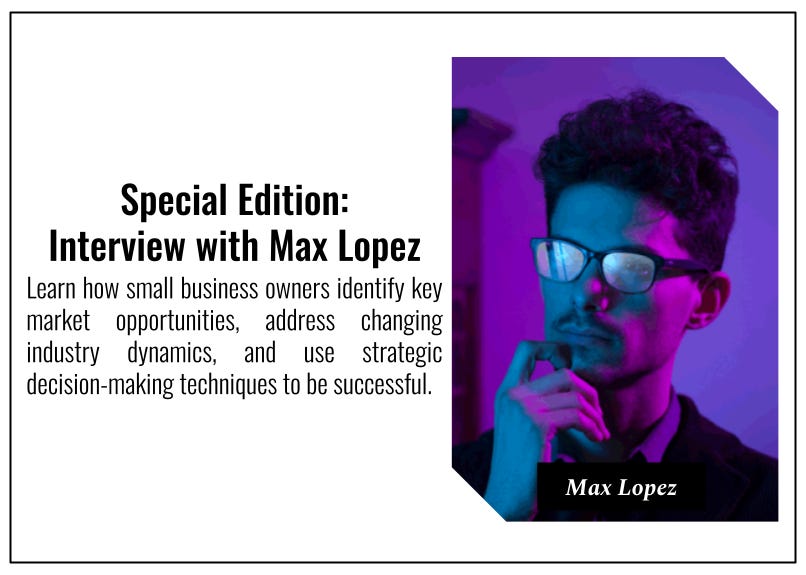
Special Edition: Interview with Max Lopez
Owner of Apartment D Films

Today’s newsletter includes an interview Q&A brought to you by… Apartment D
Apartment D is a Burbank-based provider of high-quality stop-motion animation services to consumer products companies across the United States. They specialize in working closely with toy brands to develop storylines, broaden awareness, and effectively promote their products to target audiences.
The interview Q&A provides a founder’s perspective on critical business, strategy, and career decisions, drawing on his experience as an animator and, now, as a business owner. Key points discussed today include:
Key areas of value creation relative to the competitive landscape
Identifying and addressing market opportunities as they arise
In-depth analysis of the animation industry with a focus on the different types of content and distribution channels
👋 Hello friends,
Thank you for joining this week’s edition of Brainwaves. I’m Drew Jackson, and today I’m bringing you insights from a lovely conversation I had with Max Lopez, co-founder of Apartment D.
Quick Context: New to Brainwaves? We explore the forces reshaping our world across venture capital, energy, space, economics, intellectual property, and philosophy. Subscribe here for bi-weekly deep dives plus weekly current events.
Time to Read: 14 minutes.
Let’s dive in.
Q: Background on Max and His Company
Max has been interested in the film and animation industries for almost his entire life. His formal education began in 2008, when he studied animation at the Rochester Institute of Technology, graduating in 2012 with a degree in Film and Animation. There, he met his now co-founder, Sean Malony, with whom he roomed during school (and continued living with until 2020).
They both had the goal of becoming the best animators they could be. Both recognized the importance of working hard and gaining experience at top animation studios; however, it was crucial to continue creating their own work throughout this process to level up their skills and get their voice out there. As Max puts it, “I think it always kind of seemed natural to us that that was kind of the path to whatever is next.”
In 2014, they were each working at separate studios, Max at Bix Pix Entertainment on a preschool series called Tumble Leaf and Sean at Stoopid Buddy Stoodios on Robot Chicken. At night, they compared notes on different techniques and started to develop the idea of them working together someday. In their downtime, they took on freelance projects, none of which were huge, but they allowed them to test the skills they had developed working for others.
Credit Apartment D Films
In 2016, the pair moved to a house with a garage, formally creating Apartment D Films. Like many other early-stage product founders, they used their garage space to tinker and produce some initial designs and content. To broaden their reach, they placed heavy emphasis on social media, particularly Instagram, to market their initial work. At first, their followers were immediate contacts and industry connections. Still, it enabled them to broadcast that they were serious about their process and were trying to build a real business.
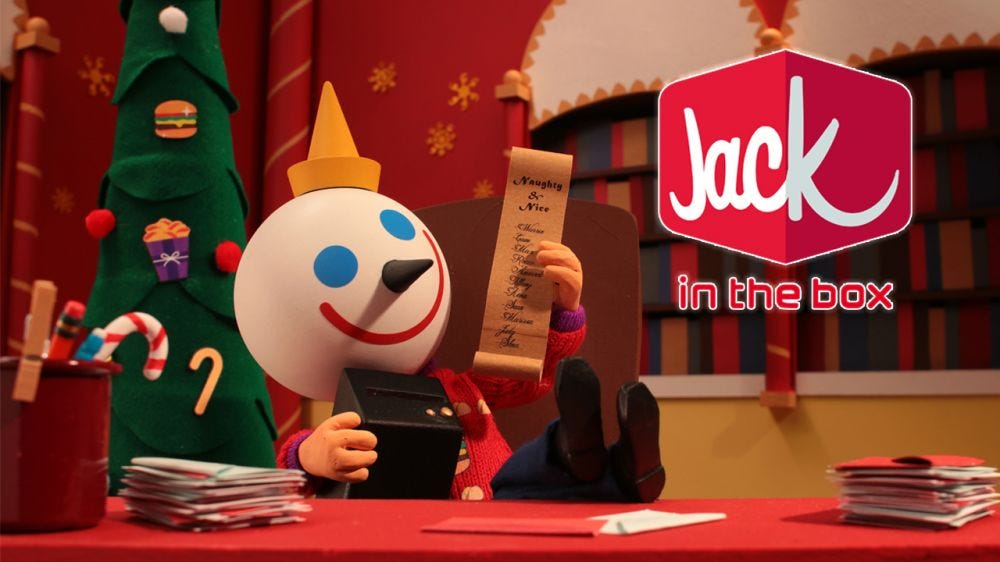
For the next 2-3 years, their work was primarily based on word-of-mouth referrals and any inbound through social media. They knew the people who would offer freelance opportunities, maybe the work was too big, or perhaps they didn’t have enough time, or maybe it was a job they simply didn’t want to do, but they always knew they could send things to Max. During this period, they completed work for the Nickelodeon YouTube channel and created a Christmas commercial.
In 2018, they bid on a small-scale commercial project on a platform called Tongal and won the opportunity to work with Mattel. Unrelated, but at this time, to fill the cracks in work at Apartment D, Sean and Max were working as freelance animators at Mattel. Max would work through his animations as quickly as possible to network through Mattel and learn more about how they could get more of these projects. As Max describes it:
Finally, I met a producer who had seen the project we had won through Tongal, and I basically went to this person and said ‘You saw what we did in the garage. You see what we do here.’ And that basically paved the way for what has grown into our largest clientele: toy companies.
Credit Apartment D Films
Since 2019, they’ve done work with most toy companies, in a services-branded entertainment fashion where they take the brand’s intellectual property and adapt it to entertainment so it can live on YouTube. They’ve also completed some more traditional entertainment work. Broadly, Max sees their work as an opportunity to live and work in entertainment without relying on the traditional economics of the entertainment industry.
However, during this period, the industry collapsed as consumer attention continued to turn away from traditional media towards platforms such as YouTube. Luckily, this worked well for the Apartment D team, as around 80-90% of their work was already for YouTube. As Max puts it:
YouTube, in a lot of ways, looks like ‘70s and ‘80s television, where it’s small, scrappy, and cheap. I always say that YouTube is kind of in its reality TV or unscripted era, as it relies on the cheapest form of content creatable.
Currently, ad revenue on YouTube isn’t that high, which creates the dynamics described above. But, as it continues to gain ground against streamers and broadcast, it’ll be able to make the argument that it deserves a higher percentage of ad revenue. This will raise the quality of content, and eventually it will come to resemble television.
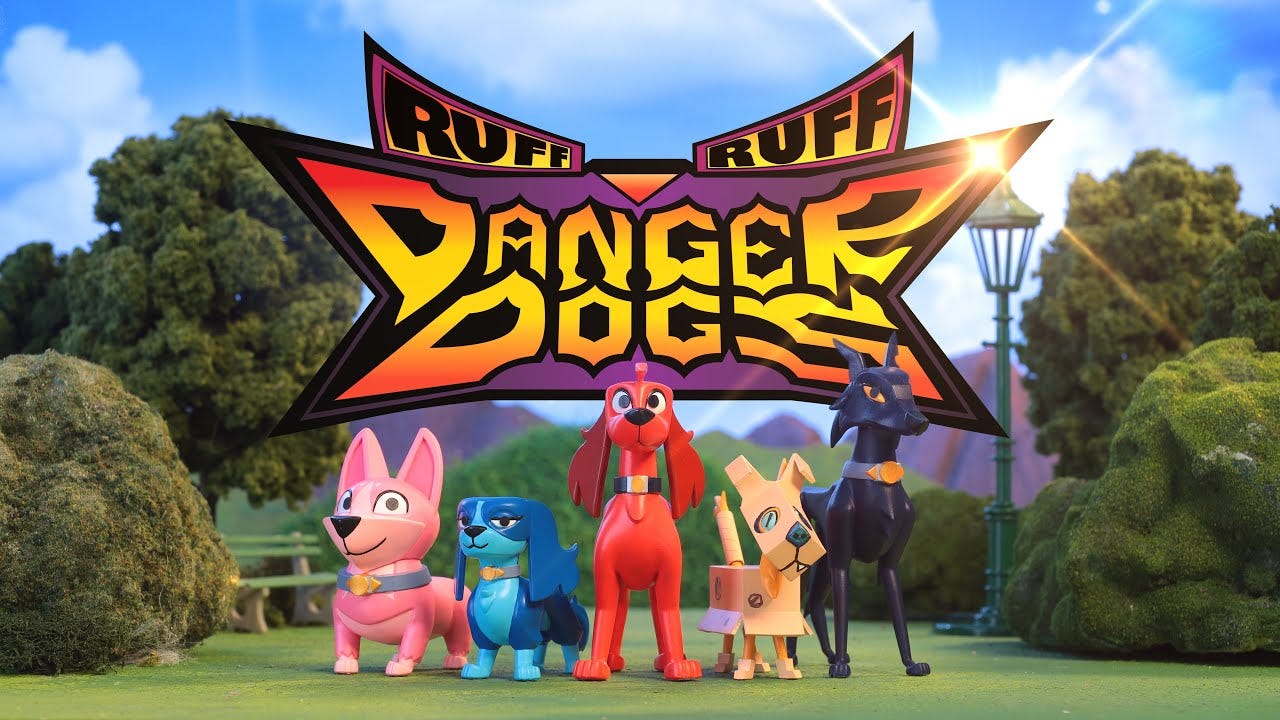
Currently, the Apartment D team continues to bet on YouTube being the future of content with their in-house Ruff Ruff Danger Dogs series, signaling they believe it’s the space they need to build a footprint in, an audience in, and break out to transition from being a service-first business to an intellectual property-first business.
Q: What are the unique dynamics of the animation and stop motion industry that everyday people won’t fully understand?
Since the 1970s, the animation industry as a whole has shifted mainly to an overseas outsourcing model. Most of the cartoons we grew up with weren’t animated in the U.S.
While stop motion has generally been protected from the trend of outsourcing because it involves physical, often fragile assets that wouldn’t withstand international shipping, there has been an adverse side effect. Stop motion is considered the “expensive” option. This is less about the actual cost of working in the medium and more about people often comparing outsourced budgets to American-made stop-motion budgets.
For the stop-motion industry, a central problem for firms looking to innovate is that it’s tough to systematize without complete creative control over the project. If you have control of the scope and parameters of a project, you can work with a skill set, tools, and visual language that’s repeatable regardless of what you’re creating. However, more often than not, in the service work, you’re at the whims of your clients, which precludes much systemization. No two projects are the same, and the resources and skills you need differ.
Apartment D is taking a newer approach to this issue, aiming to build simpler, repeatable pipelines. As such, they’ve started to view the industry from an actual manufacturing lens rather than a creative production angle. They’ve implemented 3D modelling into their design process, working with their projects in volumetric space rather than 2D. This enables them to work through more problems while decreasing the time to production.
Using their 3D designs, they can employ laser cutters, CNC routers, and 3D printers to streamline the production of characters and sets while maintaining relative flexibility. Recently, they’ve overhauled their production phase, breaking the traditional stereotype of stop motion being inflexible through the implementation of computers and manufacturing processes.
Q: What is the average timeline for one of these projects from start to finish?
Most projects are around 3 months, though the vast majority of this time is spent in smaller segments (3-10 days) where you wait for your client’s feedback in rounds of revisions. Usually, this isn’t a problem as they’re working on multiple projects at a time and can easily pivot.
Credit IMDb
For their in-house series Ruff Ruff Danger Dogs, the first episode took a year to produce. This includes the writing phase, pre-production, live-action shoots, stop-motion shoots, and post-production. The second took around 7 months, and the third is expected to take 5 months. As you can see, there are significant returns to learning and knowledge in this industry for recurring projects and processes.
Max bets that Apartment D could easily produce their series in less time if he was working full-time on it (somewhere around 45 days per episode). However, he has to wear his CEO hat of running the business, which takes time away from many of these projects.
Traditional series by bigger producers take anywhere from 9 months to 18 months to produce a single episode. They have more feedback loops, work with overseas animation vendors, which tends to cause lag, and aim for a higher-caliber, more time-intensive product.
In comparison, the process for Apartment D looks quite good, especially if more knowledge synergies are recognized as they complete more projects. They studied anime, which is notoriously resource-efficient, to figure out which practices they could adopt in their work.
One central idea was introducing a larger live-action component to reduce the effort required for stop-motion creation. Max estimates that, over their upcoming 22-minute episode, there will be about 20.5 minutes of live action and about 1.5 minutes of stop motion. What’s surprising is that the time it will take to produce each section will be about the same, truly showing how long stop motion takes.
Q: What are your plans for future growth?
Max detailed three main pillars he is working on for future growth: intellectual property, optimization, and diversification.
First, their YouTube-focused strategy and production of the in-house series Ruff Ruff Danger Dogs is a big bet on their own intellectual property. In Max’s view, this is the key to unlocking exponential growth rather than the traditional linear growth of being a service-based business. This area is a sprint for them as they try to win market share as the industry wakes up to the opportunity here and competition increases.
Second, they’ve started implementing systems to optimize their workflows. As previously highlighted, a central area was expanding the flexibility and time-to-production for stop-motion productions. Additionally, they’ve begun implementing internal project management tools to simplify the process of chasing clients for feedback and, hopefully, speed up the overall time to finish. These tools will also manage social media output, drive leads, and continue to showcase their quality workmanship to the market.
Historically, they’ve primarily worked on stop-motion animation projects; however, they have experimented a bit with 2D animation and computer-generated projects. Computer animation initially killed the stop-motion industry, but over the last two decades, the niche has reopened and grown stronger. As Max explains it:
I think as things become increasingly digital, as AI becomes increasingly part of the process, as movies become increasingly shot exclusively on a green screen, there will always be a counterculture, or a craving for the other. Stop motion has established itself as a verifiably human-made medium, so it’s kind of cemented its place now.
Despite these favorable trends, Max continues to see value in diversifying the services they can offer clients, just in case industry dynamics shift in the future. They’ve proven to their clients they can deliver the caliber of work they want, and now they want to apply that approach to other mediums.
Q: What piece of advice would you offer to anyone looking to start their own business?
When they started Apartment D, it was just three artists in a garage. It took them a long time to understand the idea that someone needed to be in charge of the business side of things. Lots of studios are focusing on making the art without having someone to focus on the business. “Nobody takes building the business seriously, and those businesses just don’t last long.”
Often, people go into business to do what their company does rather than actually run it. For instance, bakers go into business to bake bread, not necessarily to run it. You need either a partner to run the company or a person who can run it. But this part is often overlooked.
Often, business owners find they need to delegate the part of the business they enjoy to focus on running the business side. He cited a 2024 video from Marques Brownlee titled “On ‘Quitting’ YouTube,” where Marques addresses the issue of creator burnout and why many successful YouTubers decide to leave or scale back.
In the video, Marques explains that he has avoided this fate by making a conscious effort to hold onto the core activities that sparked his initial passion. He cited three core aspects that were truly at the heart of the process for him: being the face of the channel, handling product reviews and analysis, and maintaining the overall vision and creative direction.
This resonated with Max, since he’s starting to take over more of the business side and still wants to keep hold of those core things for himself to continue receiving fulfillment from the work and enjoyment from the process.
My Takeaways
First of all, it was fantastic to learn from Max and hear more about his story. It was interesting to hear about his career trajectory and his strategies for building and growing his enterprise.
I want to thank Max again for the fantastic opportunity to benefit from his insights!
A Quick Aside on My Rationale With This Approach:
My goal in reaching out to Max and people like him is to highlight that all businesses face strategic challenges at each step of the growth journey. In school, you traditionally only learn about the “best of the best”, those Fortune 500 companies that have hundreds of case studies written about them.
Yet, there’s value in the unique insights from small business owners who are on the ground, constantly navigating critical decisions every minute.
How much do I price my product? Who should I hire? How should I expand my business? What do I do if my sales are down? — All the questions that small business owners face constantly.
Now, on to the critical lessons I want to highlight from my exchange with Max.
Lesson #1: Carefully follow long-term industry dynamics
Max carefully follows the long-run industry dynamics in the animation and the broader media creation industries. This helps direct many of his strategic decisions—whether to expand into 3D modeling, to bet heavily on YouTube, or to begin emphasizing 2D animation-assisted project design.
Industry evolution can easily make or break companies, so it’s imperative that companies and owners closely follow developing trends.
I’ve previously discussed the economic Long-Run Industry Structure Model, which is a dynamic framework that enables business leaders to anticipate and profit from trends in industry competition and other dynamics.
Price and competition are obvious, significant factors in a company’s success. However, as Max illustrates, many other factors also impact future outcomes, including changing consumer demand, resource availability and allocation, labor capacity, and technological developments.
Owners and business leaders need to be aware of these factors (and more) as they drive strategic thinking and exit planning.
Lesson #2: Find ways to innovate within the status quo
In Peter Thiel’s book Zero to One, he describes a methodology for how companies can generate truly unique innovations, becoming the first and only companies in their fields. This route works for some founders; however, the vast majority of companies find themselves in the second bucket, going from 1 to n.
Max is a perfect example of this. He isn’t truly revolutionizing the animation industry or turning it on its head, but he is employing automation, 3D modelling, and other technologies to drive high-impact efficiencies.
By viewing the industry as a manufacturing industry rather than an animation and creativity industry, Max is taking a new approach to a decades-old industry.
Could this approach revolutionize the industry? Yes, there’s definitely that potential, but that comes with the scale and market presence that Max is continuing to build. In a couple of years, as the platform continues to grow, this could be a very different story.
There are many ways to innovate as you go from 1 to n. I recently wrote about another interview I did with the owner of a local pottery studio, who innovated on the culture and mentorship programs present to better align with all experience levels.
Even if you aren’t going from 0 to 1, you can be very successful going from 1 to n if you innovate more than your competitors, as Max did.
Lesson #3: Dominate your niche, but don’t forget diversification
No matter where you are in business, there is always a trade-off between going broad and going deep. For early professionals, my advice is to do both: gain vast experience and speak at a high level on many topics, but also find ways to differentiate yourself—this is where niche knowledge comes in.
For Max, this is available on a service-offering and channel basis. They’re performing very well in stop motion and are known throughout the industry. His goal is to remain elevated in that niche to continue getting contracts, work, and good referrals.
At the same time, Max doesn’t want to be fully concentrated on just stop motion. As he saw during the 1970s, this industry can be highly volatile to new business models, technology disruptions, and outsourcing. As such, he is starting to broaden their service offerings to other channels, including YouTube original content creation, 2D, and 3D animation.
Diversification helps better absorb industry and macroeconomic trends, but it can’t be a business’s entire plan. Every business is trying to diversify, so how else are you differentiating yourself?
The solution is a hybrid approach combining diversification and deep sector experience. It’s difficult to go one way or the other and succeed in the long run.
_______
I want to say another thanks to Max; it was great learning all of these things from his experience, and it is even better that I can share them with you.
I hope you read something valuable in the above discussion and takeaways that will influence how you approach business or even your life in general.
That’s a wrap on this deep dive.
Found this analysis valuable? The best way to support Brainwaves is to share it with someone who’d benefit from these insights.
Drew Jackson
Founder & Writer
Share This Analysis
Keep Exploring
Next Deep Dive: What Superforecasters Know That You Don’t - December 24th, 2025
This Saturday: Weekly roundup of breaking developments across energy, space, venture capital, economics, intellectual property, and philosophy
Previous Editions: View the archive here
Stay Connected
New to Brainwaves? Join thousands of readers getting bi-weekly deep dives into the forces reshaping our world.
Sponsor This Newsletter: Reach an engaged audience of forward-thinking readers. Email us for details.
Disclaimer: Views expressed are personal opinions, not financial advice. This content is educational only. Investment decisions carry risks - always consult professionals and do your own research. All sponsorships are clearly disclosed.
© 2025 Brainwaves. All rights reserved.